In-situ testing forms the backbone of reliable geotechnical engineering in Hialeah, providing direct measurements of soil and material properties without disturbing their natural state. This category encompasses a range of field investigations that evaluate ground conditions exactly where they exist, delivering data that laboratory tests alone cannot replicate. For a city built on challenging South Florida terrain, these methods are essential for verifying compaction, assessing bearing capacity, and ensuring compliance with design specifications. From residential subdivisions to commercial warehouses, in-situ tests like the field density test (sand cone method) give engineers and contractors the confidence that foundations will perform as intended over decades of service.
Hialeah sits atop the Biscayne Aquifer, with subsurface conditions dominated by porous Miami Limestone, pockets of sand, and organic silts. This geology creates unique challenges: dissolution features can lead to sudden voids, while the shallow water table amplifies risks of settlement and buoyancy. In-situ testing is particularly vital here because disturbed samples lose critical information about cementation, natural moisture content, and density stratification. Methods such as Standard Penetration Tests (SPT) and Cone Penetration Tests (CPT) map these variable layers, while nuclear density gauges and sand cone tests confirm that compacted fills meet the required thresholds to prevent differential settlement in structures ranging from single-family homes to the industrial parks near the Miami-Opa Locka Executive Airport.
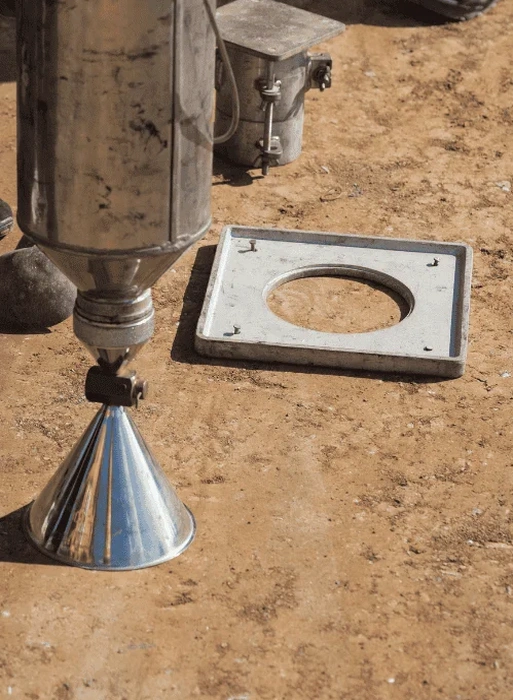
All in-situ testing performed in Hialeah must adhere to the Florida Building Code (FBC), which incorporates relevant ASTM standards and local amendments for Miami-Dade County. The county's Department of Regulatory and Economic Resources mandates specific testing frequencies and procedures, particularly for earthwork and foundation inspections. ASTM D1556 governs the sand cone method for field density determination, while ASTM D6938 covers nuclear gauge operation. These protocols ensure that results are defensible and consistent across projects. Additionally, Florida Administrative Code Chapter 61-20 outlines requirements for geotechnical investigations in areas with high environmental sensitivity, such as those near the Everglades buffer zones that influence Hialeah's western perimeter.
The types of projects that demand comprehensive in-situ testing in Hialeah span the full construction spectrum. New residential developments, especially the townhome communities replacing older single-family lots, require density verification for structural fill and pavement subgrades. Commercial projects—from the bustling retail corridors along West 49th Street to the logistics centers near the Palmetto Expressway—depend on plate load tests and pressuremeter testing to design shallow foundations that cope with variable limestone pinnacles. Infrastructure work, including stormwater drainage systems and roadway widening under the Florida Department of Transportation's specifications, relies heavily on in-situ permeability tests and moisture-density relationships to prevent future pavement failures. Even smaller projects like pool installations and retaining walls benefit from rapid, on-site assessments that keep construction schedules on track without sacrificing safety.
Available services
Common questions
What is in-situ testing and why is it preferred for Hialeah's soil conditions?
In-situ testing evaluates soil and rock properties directly in the field without removing samples from their natural environment. This approach is preferred in Hialeah because the local Miami Limestone and sandy soils can be highly variable, with natural cementation and moisture content that are lost during sampling and transport. Tests like CPT, SPT, and field density methods capture the true behavior of these materials under existing stress conditions, providing more reliable data for foundation design and compaction control.
Which ASTM standards govern in-situ testing for projects in Hialeah?
The Florida Building Code and Miami-Dade County amendments require adherence to several ASTM standards. ASTM D1556 covers the sand cone method for field density, ASTM D6938 regulates nuclear gauge use, ASTM D1586 governs the Standard Penetration Test (SPT), and ASTM D5778 applies to Cone Penetration Testing (CPT). These standards define equipment calibration, test procedures, and reporting formats to ensure results are consistent and legally defensible during the county permitting process.
How does the high water table in Hialeah affect in-situ testing procedures?
The shallow groundwater in Hialeah, often within a few feet of the surface, can complicate in-situ tests by causing borehole instability, affecting density readings, and altering soil strength. Testing protocols must account for these conditions, sometimes requiring casing, dewatering, or specialized interpretation. For density tests, moisture corrections are critical because saturated soils behave differently under compaction; ignoring water table effects can lead to inaccurate assessments of bearing capacity and settlement potential.
When does Miami-Dade County require in-situ density testing during construction?
Miami-Dade County typically mandates field density testing for any project involving structural fill placement, including building pads, road subgrades, and utility trench backfill. The frequency is usually specified as one test per lift of compacted material per a defined area, often every 2,500 square feet or as directed by the project's geotechnical engineer. These tests must be performed by qualified technicians and submitted as part of the inspection records before the county issues a certificate of completion or occupancy.