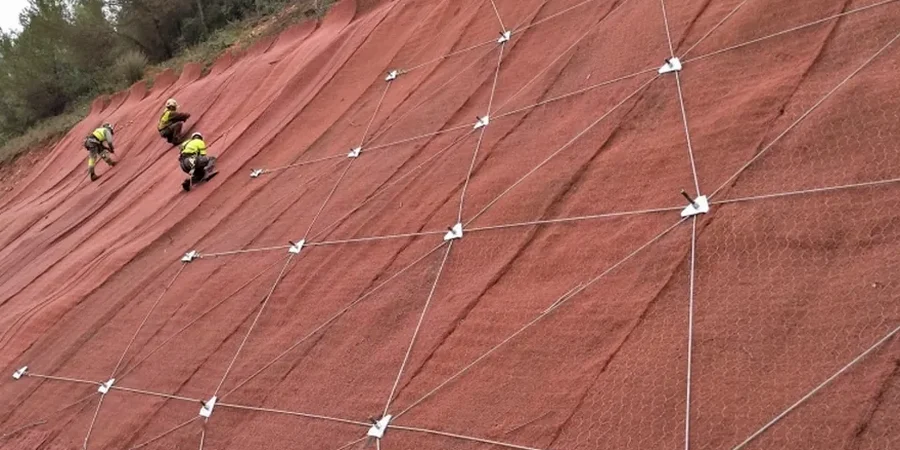
Slope and wall engineering in Hialeah addresses the critical intersection of natural terrain, constructed earthworks, and structural retention systems within a densely developed urban landscape. This category encompasses the analysis, design, and remediation of soil and rock slopes alongside retaining structures, ensuring stability for residential, commercial, and infrastructure projects. Given Hialeah's flat topography overlying porous limestone, even minor excavations or fill placements can trigger instability if not properly engineered. Our work integrates active/passive anchor design to reinforce cut slopes and wall backfills, providing tensile capacity that counters driving forces.
The local geology is dominated by the Miami Limestone formation, a young, variably cemented carbonate rock with interbedded sand and clay lenses. This formation exhibits solution cavities, irregular pinnacle weathering, and low intact strength, creating unpredictable bearing and sliding surfaces. Seasonal heavy rainfall and a shallow water table exacerbate conditions by saturating surficial soils, reducing effective stress and triggering seepage-driven failures. In Hialeah, even shallow slopes along canals, retention ponds, and roadway embankments demand rigorous slope stability analysis to evaluate rotational, translational, and block failure modes under both drained and undrained conditions.
Regulatory compliance in Florida falls under the Florida Building Code (FBC) 2023, which incorporates ASCE 7-22 for minimum design loads and references AASHTO LRFD for transportation-related walls. Chapter 18 of the FBC governs soils and foundations, requiring global stability analyses with minimum factors of safety of 1.5 for permanent slopes and 1.3 for temporary cuts. Local amendments in Miami-Dade County, including Hialeah, enforce stricter drainage and erosion control standards per the South Florida Water Management District's Environmental Resource Permitting. All retaining wall design must account for hydrostatic and hydrodynamic loads, with cantilevered, gravity, and mechanically stabilized earth (MSE) walls requiring sealed calculations demonstrating internal and external stability.
Typical projects demanding these operations include canal bank stabilization for the city's extensive drainage network, foundation excavation support for mid-rise buildings along East 4th Avenue, and MSE walls for commercial developments near the Palmetto Expressway. Roadway widening under FDOT jurisdiction often triggers slope regrading with soil nail or tieback anchor reinforcement. Residential pool enclosures and terraced landscaping on artificially filled lots also benefit from integrated slope and wall assessments to prevent surficial sloughing and long-term creep. Each project type requires a tailored combination of subsurface investigation, laboratory shear strength testing, and limit equilibrium or finite element modeling to capture site-specific failure mechanisms.
Common questions
What are the most common causes of slope and retaining wall failures in Hialeah?
Failures typically stem from inadequate drainage control, leading to pore pressure buildup in the Miami Limestone's porous matrix, or from underestimating solution cavity collapse loads. Poor compaction of fill over irregular pinnacle bedrock and insufficient global stability analysis for canal bank slopes under fluctuating water levels are also frequent contributors.
How does the Florida Building Code regulate slope and wall design differently from other states?
The FBC mandates site-specific geotechnical investigations for any wall over 4 feet and requires global stability with a minimum factor of safety of 1.5. Unique to Florida are stringent hydrostatic load provisions due to the high water table and hurricane-driven saturation, plus Miami-Dade's environmental permitting requirements for discharge and erosion control.
What types of retaining walls are best suited for Hialeah's soil conditions?
Cantilever reinforced concrete walls on deep foundations often perform well where pinnacle limestone provides competent bearing. Mechanically stabilized earth (MSE) walls with granular backfill are effective for taller fills but require careful drainage design. Anchored soldier pile walls excel in temporary excavations where space is limited and the limestone can accept grouted tiebacks.
When is a slope stability analysis required for a residential property in Hialeah?
An analysis is triggered when grading alters slopes steeper than 2:1, when structures are placed near canal banks or retention ponds, or when fill is placed over existing slopes exceeding 5 feet in height. The FBC also requires analysis if site history indicates previous instability or if visual evidence of tension cracks or seepage exists.